Guide

How Children Learn to Draw

A developmental guide for parents and teachers — what to expect at each age, what the research says, and how to support your child without pressure.

By [Your name], [your role]
Published [date] · Last updated [date]

A child drawing at a table

If you have a child who loves to draw — or one who says "I can't draw" — it helps to know what's normal at their age. Children's drawing develops in fairly predictable stages, and what looks like a "bad drawing" to an adult is often a child doing exactly what their brain is capable of at that moment.

This page is a plain-language guide to how children learn to draw between ages 3 and 12+. It draws on developmental research that's been going for almost eighty years, plus more recent neuroscience and education studies. At the end, I'll explain how I use this research to design the tutorials on this site.

The four stages of children's drawing

The standard developmental framework comes from Viktor Lowenfeld, an art educator whose 1947 book Creative and Mental Growth identified stages that children pass through as they learn to draw. Almost eighty years on, his model is still widely used in teaching and research on children's drawing.1 A 2025 empirical study of 218 children's drawings in Madrid confirmed that under standard conditions, children do progress through Lowenfeld's stages in the order he predicted.1

Each stage is roughly tied to age, but with a lot of individual variation — some 3-year-olds are clearly in the next stage already, and some 5-year-olds are still happily in the previous one. That's completely normal.

Ages 1–3 · Stage 1

The Scribbling Stage

At this age, children draw for the pleasure of moving their hand and seeing marks appear. Early on, the marks are uncontrolled; later, children start to repeat shapes deliberately and may start naming their scribbles ("that's a doggy") even when an adult sees nothing recognisable.2

What's developing: the basic understanding that hand movements make marks — the foundation of all drawing. Grip is improving from a whole-fist grasp toward the tripod grip needed for writing later.

What to do: provide big paper, chunky crayons or markers, and time. Don't ask "what is it?" — ask "tell me about your picture." Avoid colouring books at this age; the open space is more valuable than the lines.

Ages 3–4 (sometimes up to 7) · Stage 2

The Preschematic Stage

The big shift: children start drawing things on purpose. A circle becomes a head; lines become legs. Figures are often "tadpole people" — a head with legs coming straight out of it, no body. Objects float on the page without a baseline; size is based on importance rather than reality (a parent might be smaller than a flower the child loves).2

What's developing: the link between mental image and mark on paper. This is when drawing starts to do real cognitive work — children are translating ideas into symbols.

What to do: ask about their drawings (their explanation tells you what they're working on mentally). Avoid correcting proportions. Introduce a wide variety of subjects — animals, family, vehicles — to give them more "symbols" to play with.

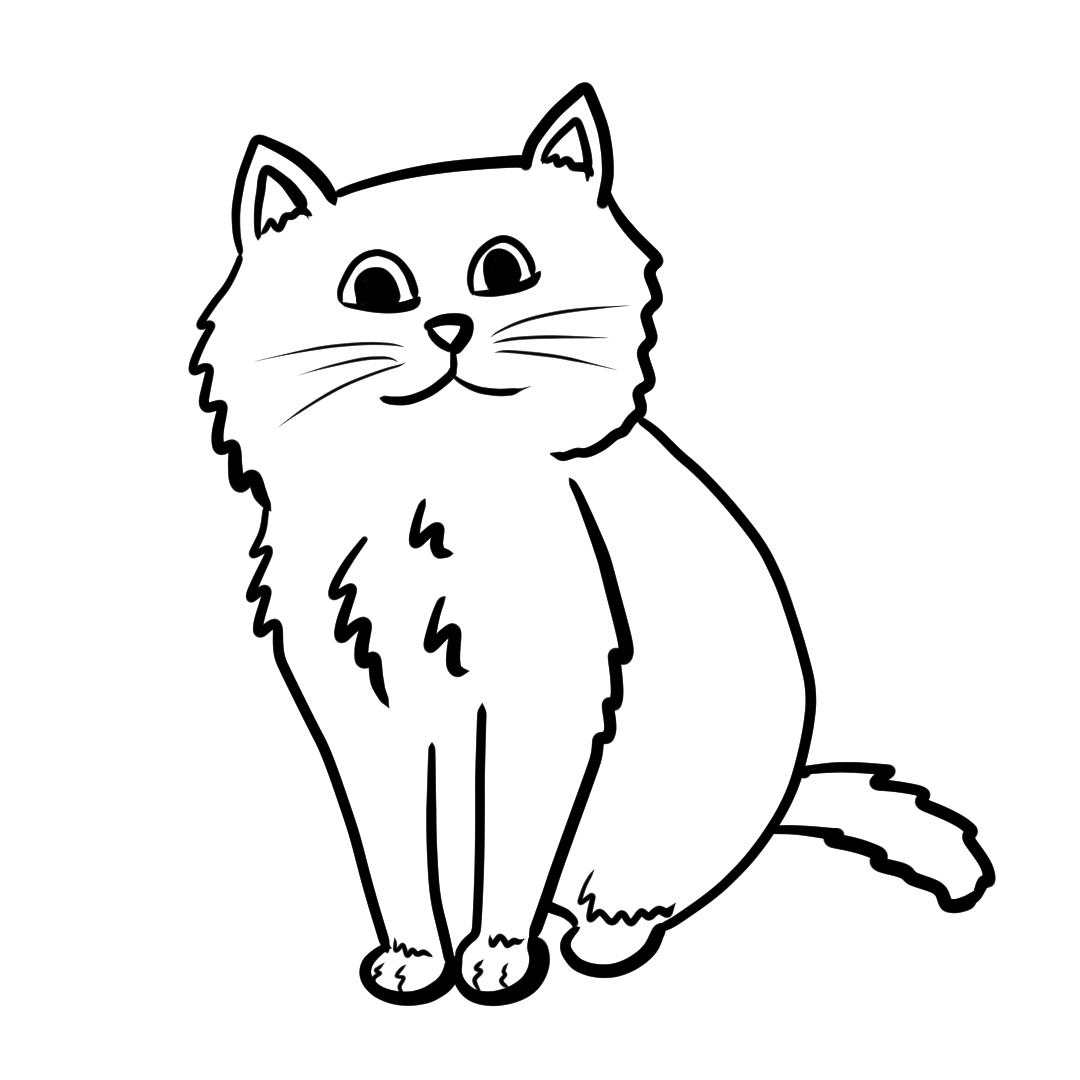
Tutorials on this site that suit this stage Simple Cat · Cat Face · Bunny Face
Ages 5–8 · Stage 3

The Schematic Stage

Children now have schemas — repeatable ways of drawing things. Every house looks the same. Every tree is the same shape. This isn't a lack of imagination; it's a major cognitive achievement. The child has internalised a symbol for "house" or "tree" and can deploy it reliably.2 A baseline appears: ground at the bottom, sky at the top. Objects are placed in relation to each other rather than floating.

What's developing: spatial reasoning, sequencing, and the ability to plan a composition before drawing. This is also the age when fine motor skills are catching up — children can now make the marks they intend to make.

What to do: this is the sweet spot for step-by-step tutorials. Children at this stage genuinely benefit from being shown how to break a complex thing (a cat) into a sequence of simple shapes. They're learning that drawing has a process, not just an outcome.

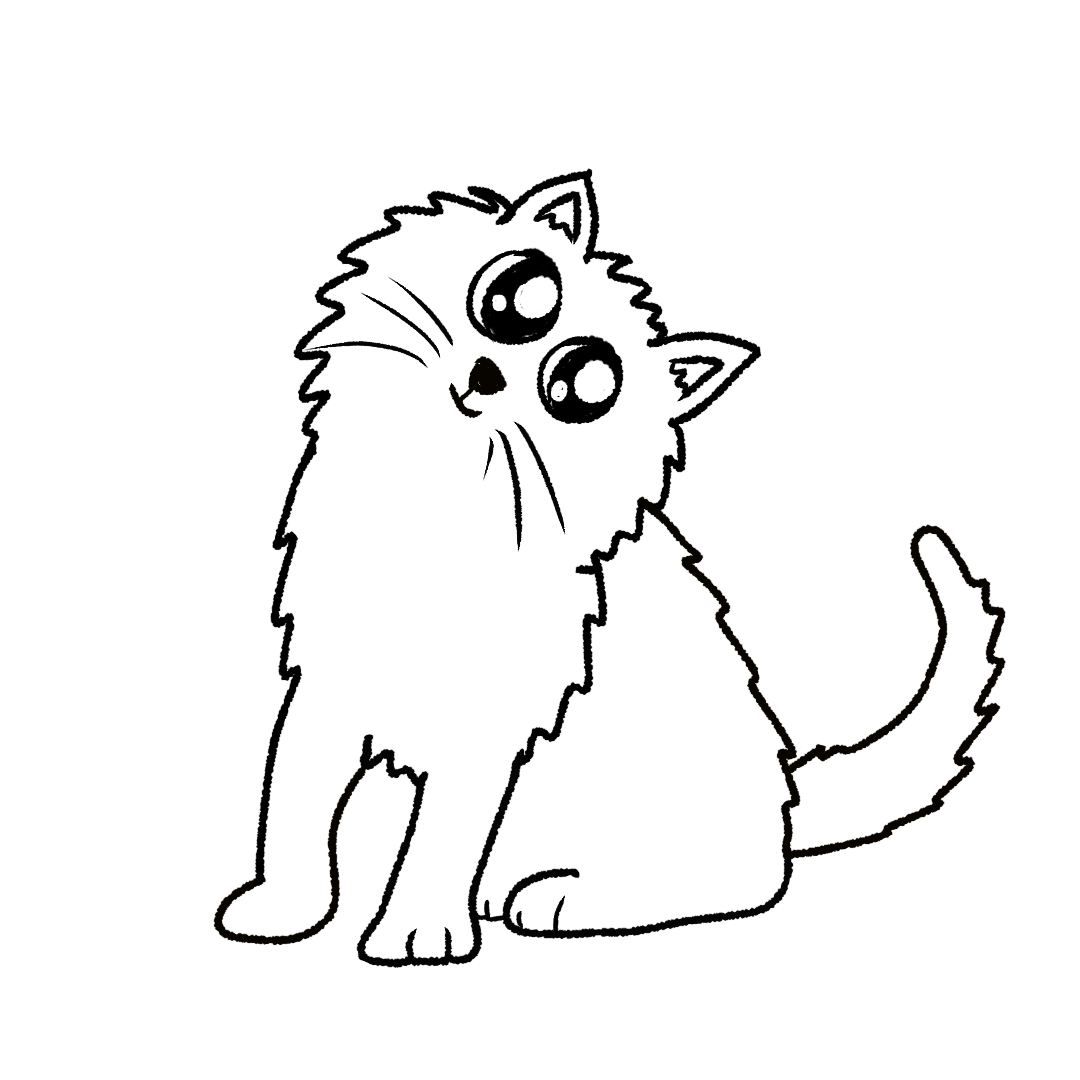
Tutorials on this site that suit this stage Cute Cat · Dog Face · Fluffy Cat
Ages 9–12 · Stage 4

The Dawning Realism Stage

Children become their own toughest critics. They notice their drawings don't look "real" — and they want them to. This is also the stage at which many children quit drawing, because the gap between what they can do and what they want to do becomes obvious. Spatial relationships, overlap, and basic perspective start to appear in their work.2

What's developing: self-critique, observational drawing, proportion, and the beginnings of perspective. Cognitively, children at this stage can hold an idea of "what something really looks like" and compare their drawing to it.

What to do: take their frustration seriously — don't say "it looks great" if they don't think it does. Introduce techniques (light proportion guides, basic perspective, shading) that give them more control. Reassure that struggle at this stage is universal, not a sign of lack of talent.

One last point on stages: there's an earlier researcher, Rhoda Kellogg, who specifically studied very young children's drawings. Her archive contains over 7,900 reproductions, with detailed categorisations of the marks children make in the scribble and pre-schema stages.3 If your child is under 5, Kellogg's work has more granular detail than Lowenfeld's.

Why drawing matters more than people think

For a long time, drawing was treated as "just play." Recent research increasingly disagrees.

A 2024 study from the University of Surrey and Birkbeck, University of London tracked over 9,000 preschool children, assessing them at ages 2, 3 and 4 on fine motor skills including drawing, paper folding, and block building. The headline finding: fine motor skills in early childhood were associated with higher GCSE grades at age 16, and lower preschool fine motor skills were associated with more behavioural problems and more ADHD symptoms during primary and secondary school.4

The authors made the implication explicit: activities like drawing and block building, often dismissed as "just play," appear to be part of the pathway leading to later educational outcomes and behaviour.4

There's a broader literature backing this up. Children's fine motor skills are linked not only to drawing ability but to cognitive, social-emotional, self-regulatory, and academic development.5 Neuroscience studies have mapped what drawing engages in the brain: a 2021 meta-analysis identified the neural networks active during drawing, and a separate analysis showed substantial overlap between the sensorimotor activations of drawing and writing.6

In plain language: time spent drawing isn't time taken away from "real" learning. It's part of what builds the foundation for reading, writing, and self-regulation.
How to help your child without taking over

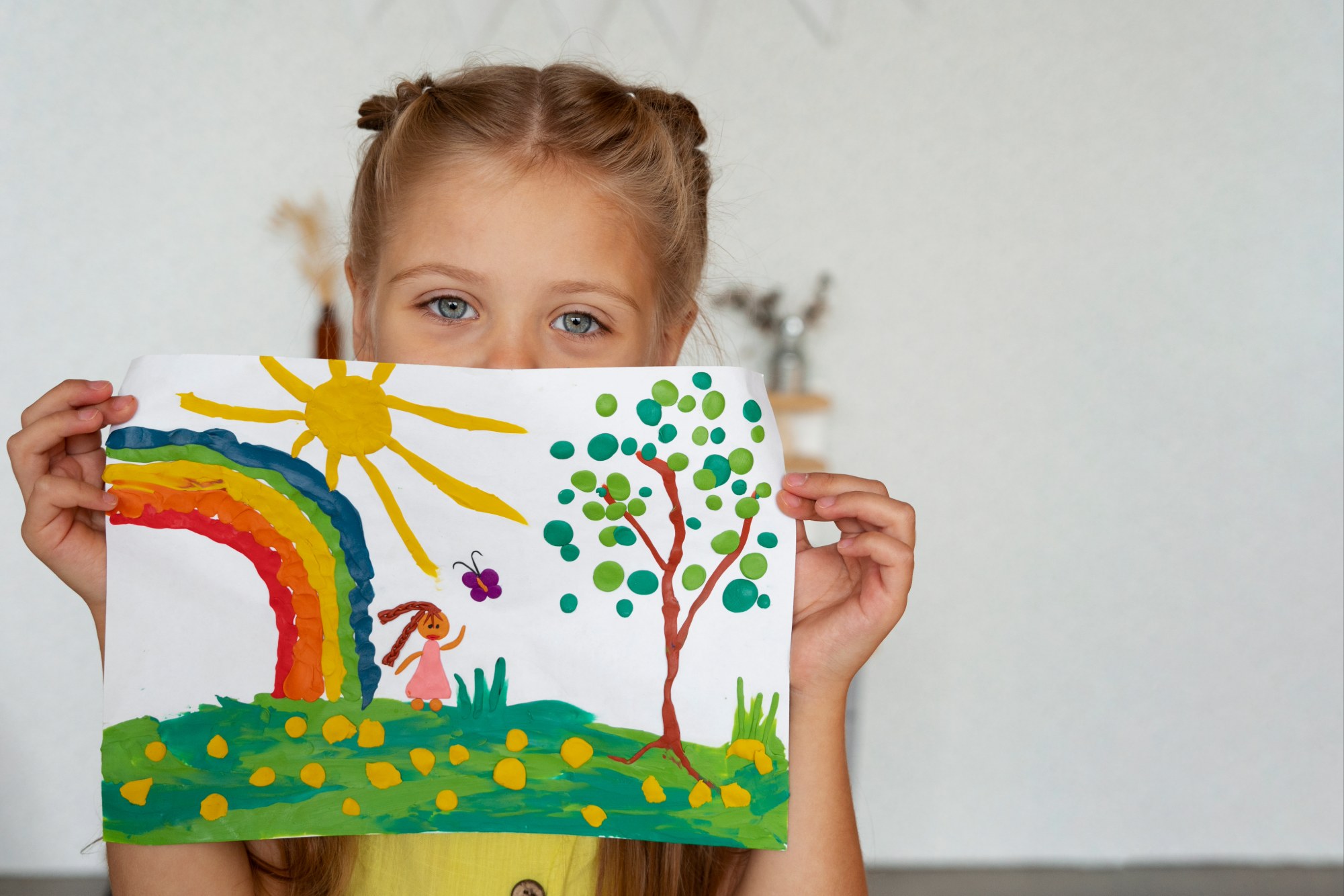
The art education research is fairly consistent on what works. Five things, in rough order of importance:

1

Praise the effort, not the result

Saying "you're so talented" sounds encouraging but it can backfire — children come to believe that "good at drawing" is a fixed trait they either have or don't have. When the drawings get harder (around the dawning realism stage), they decide they don't have it and quit. Praise what they did: "I love how you chose green fur for that tiger" or "you took your time on those whiskers."

2

Don't fix their drawings

Resist the urge to take the pencil and "show them how." Even with good intentions, this teaches the child that their version was wrong. If they ask for help, demonstrate on your own paper, then hand the task back.

3

Process matters more than product

It's tempting to focus on whether the drawing looks good. The research consistently says: don't. The valuable thing happening is the practice itself — the hand-eye coordination, the planning, the decision-making. A "bad" drawing produced through focused effort is more valuable than a "good" one traced without thought.

4

Provide variety, not pressure

Step-by-step tutorials are one mode. Free drawing is another. Drawing from observation (looking at a real cat) is a third. Drawing from imagination is a fourth. Children benefit from all of these. If a child only ever follows tutorials, they may struggle to invent on their own; if they only ever free-draw, they miss the structural learning that tutorials provide. Mix it up.

5

Notice when they're stuck — and back off

If your child is frustrated, the answer is almost never "try harder." The answer is usually one of: take a break, switch to a simpler subject, change materials (markers instead of pencil), or just stop for the day. Forcing a frustrated child to finish a drawing is a reliable way to make them not want to draw next time.

Are step-by-step tutorials any good?

This is a fair question, because critics of directed drawing argue it stifles creativity. The research suggests a more balanced answer.

Step-by-step tutorials work well as scaffolding — a teaching technique where adults provide structure that helps a child do something they couldn't yet do alone, and then gradually fade that structure as the child grows more capable. This is straight out of Vygotsky's "zone of proximal development" theory and is one of the most well-established frameworks in education.

Specific benefits that the literature on directed drawing identifies:

  • Sequencing. Following steps in order is itself a cognitive skill. Drawing teaches "this comes first, then this, then this" — which is the same skill children need for writing, maths, and following instructions generally.
  • Confidence. Children who consistently produce drawings they're happy with are more likely to keep drawing. A step-by-step that works gives them a successful experience to build on.
  • Fine motor practice. Each step requires deliberate small movements. This is real motor practice, the same kind that benefits writing later.
  • Schema building. At the schematic stage (5–8), children are actively learning that complex objects can be broken into simpler shapes. Step-by-step tutorials make this process visible.

The legitimate critique is that copying alone is not enough. A child who only ever follows tutorials never practises generating their own ideas. This is why on every tutorial on this site, I include a "now try your own version" prompt at the end — change the colours, swap the ears, draw the same cat sleeping instead of sitting. Tutorial as starting point, not finishing point.

The cyan-line method we use here

Most drawing tutorials show "draw this" on each step and expect the child to figure out exactly where on the page it goes. That works for some children. For many — especially at the schematic stage when spatial planning is still developing — it doesn't.

The tutorials on this site use a specific visual convention: each step shows the existing drawing in black, and the new line you're adding in cyan blue. The child knows immediately what to add, where it goes, and how it relates to what's already there.

This is a form of visible scaffolding. The cyan line is the structure; the child does the drawing. As children work through more tutorials, they internalise the underlying logic ("the body comes from the bottom of the head, about this wide") and gradually stop needing the cyan guides at all — they can plan independently. That's the goal: scaffolding that fades.

It's a small design choice but it makes a real difference for children who'd otherwise get stuck on "where does it go?" instead of focusing on the drawing itself.

Common myths about kids and drawing

Myth

"Some children are just naturally talented at drawing; others aren't."

What the research says

Drawing develops through stages roughly tied to age and practice, not innate talent. A child who draws every day at age 6 will be ahead of a child who doesn't, regardless of "natural ability." The biggest predictor of late-childhood drawing skill is hours of practice during the schematic stage.

Myth

"Copying drawings stops children from being creative."

What the research says

Copying does not automatically reduce creativity. Problems arise when children are pressured to copy perfectly, or when copying is the only mode they're given. Used alongside free drawing and observational drawing, structured copying actively supports creative development by giving children a wider repertoire of shapes and techniques to remix.

Myth

"My child should be drawing better by now."

What the research says

The age bands in Lowenfeld's stages are rough averages with wide individual variation. Some 5-year-olds are still in the scribbling stage; some 7-year-olds are already showing dawning-realism features. The 2025 Madrid study explicitly documented prolonged persistence in early stages as normal variation, not a problem. Don't compare your child to a sibling, classmate, or social media post.

Myth

"My child says 'I can't draw' — they must not be artistic."

What the research says

"I can't draw" usually appears around ages 8–10, at the start of dawning realism. It's a sign the child is becoming aware of the gap between their current ability and adult-level realism — which is itself a cognitive milestone. The best response is to acknowledge the frustration is real and universal, not to dismiss it. Many adults who say they can't draw simply quit at this stage and never restarted.

[Your name]
About the author [Your bio — 2–3 sentences. Who you are, relevant experience with children's art, why you started How To Draw Place. A real photo helps a lot.]
References
  1. Mallo, B., et al. (2025). Children's Drawing and Graphic Development: An Empirical Study of the Developmental Stages According to Lowenfeld. Education Sciences, 15(6), 681. mdpi.com/2227-7102/15/6/681
  2. Lowenfeld, V. (1947). Creative and Mental Growth. Macmillan. The original source for the four-stage developmental model; summaries available through the MDPI study above.
  3. Brown, S. (2018). A Comparative Study of Rhoda Kellogg's Children's Artistic Development Research. Purdue University. Purdue archive
  4. Bowler, A., Arichi, T., Fearon, P., et al. (2024). University of Surrey / Birkbeck, University of London. Press summary: ScienceDaily
  5. Springer (2021). Detecting Children's Fine Motor Skill Development using Machine Learning. International Journal of Artificial Intelligence in Education. link.springer.com
  6. Raimo, S., Santangelo, G., & Trojano, L. (2021). The neural bases of drawing. Neuropsychology Review, 31, 689–702. See also Yuan & Brown (2015), Drawing and writing: An ALE meta-analysis of sensorimotor activations. Brain and Cognition, 98, 15–26.
Ready to start drawing?
Simple Cat

Simple Cat

Cute Cat

Cute Cat

Bunny Face

Bunny Face